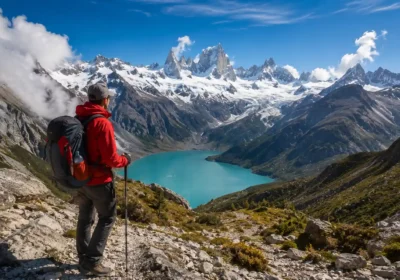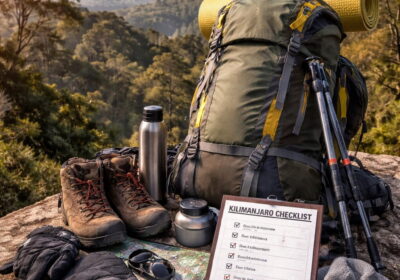
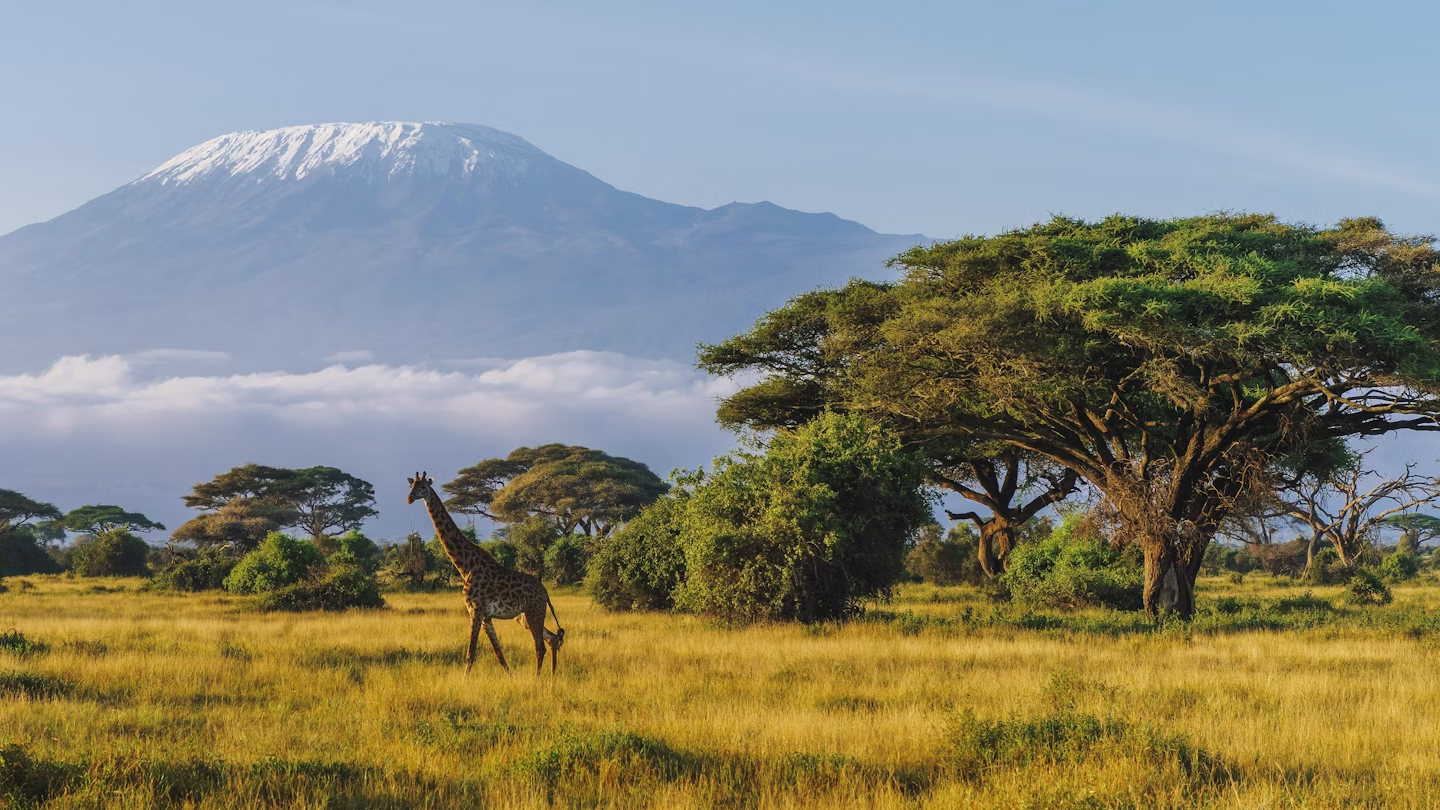
If you’ve ever watched experienced mountaineers descend a steep mountain trail, you have probably noticed one common piece of gear almost every serious trekker carries: trekking poles.
For years, trekking poles were unfairly associated with older hikers or beginners who needed extra support. That perception has completely changed. In 2026, trekking poles are considered essential equipment for everyone from casual hikers to elite alpine climbers.
Professional guides on Mount Kilimanjaro, Everest Base Camp, Patagonia, the Inca Trail, and the Alps all recommend trekking poles for one simple reason:
They work.
Trekking poles are not just about balance. They improve endurance, reduce joint strain, increase stability, enhance posture, conserve energy, and help trekkers hike more safely over difficult terrain.
In fact, many experienced hikers consider trekking poles one of the most important long-term investments you can make for protecting your knees, back, and overall mobility throughout a lifetime of adventure travel.
In this 2026 guide, we break down the major benefits of trekking poles, explain how to use them properly, and show why they have become standard gear for serious trekkers around the world.
Why Trekking Poles Matter More Than Ever
Modern trekking has changed dramatically over the last decade.
More travelers are now attempting:
- Multi-day mountain treks
- High-altitude expeditions
- Long-distance backpacking routes
- Technical descents
- Glacier crossings
- Adventure travel itineraries
At the same time, many people are hiking later into adulthood and prioritizing long-term joint health.
This is exactly where trekking poles become incredibly valuable.
A good pair of poles does far more than simply “help you walk.” They fundamentally change how your body handles stress during hiking.
Instead of placing all impact and pressure on your knees, hips, and ankles, trekking poles distribute some of the workload into your upper body.
The result is:
- Better balance
- Reduced fatigue
- Lower injury risk
- Improved endurance
- More confidence on rough terrain
For many trekkers, poles become the difference between finishing a trek feeling exhausted and finishing with energy still left in the tank.
The Biggest Benefit: Protecting Your Knees
One of the most important reasons to use trekking poles is joint protection.
This becomes especially obvious during downhill descents.
Many hikers assume climbing uphill is the hardest part of trekking. In reality, descents often place far greater stress on the body.
When hiking downhill, every step sends compressive force through your:
- Knees
- Ankles
- Hips
- Lower back
Over the course of a long trek, this repeated impact adds up significantly.
Research has shown that trekking poles can reduce pressure on the knees by up to 25% during descents.
That is enormous.
On multi-day hikes like:
- The Inca Trail
- Salkantay Trek
- Tour du Mont Blanc
- Everest Base Camp
- Torres del Paine
this reduction in joint stress can dramatically improve comfort and recovery.
Trekkers with previous knee injuries often notice immediate improvement once they begin using poles correctly.
Even young, healthy hikers benefit because trekking poles help preserve joint longevity over years of hiking.
Trekking Poles Improve Stability and Balance
Mountain terrain is unpredictable.
Trails may include:
- Loose rocks
- Mud
- Wet roots
- Snow
- Ice
- River crossings
- Uneven steps
- Scree slopes
Without trekking poles, your body relies entirely on two points of contact: your feet.
Adding poles creates a four-point support system, dramatically improving stability.
Many hikers describe this as “four-wheel drive for trekking.”
This added stability becomes incredibly valuable during:
Stream Crossings
Wet rocks are notoriously slippery.
Trekking poles allow you to test footing before committing your full weight.
Snow and Ice
Even lightweight poles provide additional balance that helps prevent dangerous slips.
Loose Gravel and Scree
Descending loose terrain becomes much more controlled with trekking poles.
Rainy Conditions
Wet trails increase slipping risk significantly. Poles provide extra traction and confidence.
For beginner trekkers especially, poles often reduce fear and hesitation on technical terrain.
Trekking Poles Improve Posture and Breathing
As fatigue builds during long hikes, most people naturally begin leaning forward and hunching over.
This posture creates several problems:
- Restricted breathing
- Tight shoulders
- Lower back strain
- Reduced lung expansion
- Poor balance
Trekking poles encourage hikers to remain more upright.
This posture keeps the chest open and allows the lungs to expand more efficiently.
At high altitude, proper breathing becomes critically important.
When oxygen levels decrease, even small improvements in breathing efficiency can significantly impact energy levels and endurance.
This is one reason trekking poles are so popular on high-altitude routes like:
- Kilimanjaro
- Everest Base Camp
- Salkantay Trek
- Annapurna Circuit
Maintaining good posture helps trekkers conserve energy while improving oxygen intake.
Trekking Poles Turn Hiking Into a Full-Body Workout
Without poles, hiking is heavily dominated by the lower body.
Your:
- Quadriceps
- Hamstrings
- Calves
- Glutes
handle nearly all the workload.
Trekking poles change this dynamic by engaging:
- Triceps
- Shoulders
- Chest
- Core muscles
- Upper back
This creates a more balanced physical effort across the entire body.
Instead of your legs absorbing all the strain, trekking poles help distribute energy more efficiently.
This becomes especially valuable during:
- Long trekking days
- Steep climbs
- Multi-day expeditions
- Heavy backpack carries
Many trekkers notice they can maintain a steadier pace for longer periods when using poles properly.
Trekking Poles Help Reduce Fatigue
Fatigue during trekking is cumulative.
Small energy savings throughout the day eventually become significant.
By improving efficiency and reducing strain, trekking poles help preserve energy reserves over time.
This becomes especially noticeable on:
- Day 3 or 4 of a trek
- Long descents
- High-altitude routes
- Technical terrain
Trekkers who begin using poles often report:
- Less soreness after hiking
- Faster recovery between days
- Better balance late in the day
- Reduced muscle exhaustion
Energy conservation becomes even more important during expedition-style trekking where recovery opportunities are limited.
Confidence and Mental Benefits
One overlooked advantage of trekking poles is psychological confidence.
Many hikers feel significantly more secure when using poles.
This confidence helps reduce:
- Fear of slipping
- Anxiety on descents
- Hesitation during crossings
- Mental fatigue
When trekkers feel more stable, they move more naturally and efficiently.
Confidence improves rhythm and reduces unnecessary tension throughout the body.
This mental comfort becomes especially valuable for:
- Beginner hikers
- Older trekkers
- High-altitude trekkers
- Travelers carrying heavy backpacks
How to Choose the Right Trekking Poles
Not all trekking poles are equal.
The right poles depend on your hiking style, budget, and terrain.
Aluminum vs Carbon Fiber
Aluminum Poles
Advantages:
- More durable
- Better for rugged terrain
- Less likely to snap under stress
- Usually more affordable
Disadvantages:
- Slightly heavier
Carbon Fiber Poles
Advantages:
- Extremely lightweight
- Excellent vibration absorption
- Comfortable during long hikes
Disadvantages:
- More expensive
- Can crack under severe impact
For most trekkers, aluminum offers the best balance between durability and price.
Folding vs Telescoping Poles
Folding Poles
- Compact for travel
- Lightweight
- Popular among trail runners
Telescoping Poles
- More adjustable
- Often sturdier
- Better for varied terrain
Travelers doing international trekking often prefer compact folding poles because they pack easily into luggage.
Grip Material Matters
Trekking pole grips usually come in:
- Cork
- Foam
- Rubber
Cork
- Comfortable
- Moisture-wicking
- Molds to your hand over time
Foam
- Lightweight
- Soft
- Comfortable in hot weather
Rubber
- Durable
- Better for cold conditions
Most long-distance trekkers prefer cork or foam for comfort during extended use.
The Correct Trekking Pole Technique
Many people carry trekking poles but never actually learn how to use them properly.
Poor technique reduces many of the benefits.
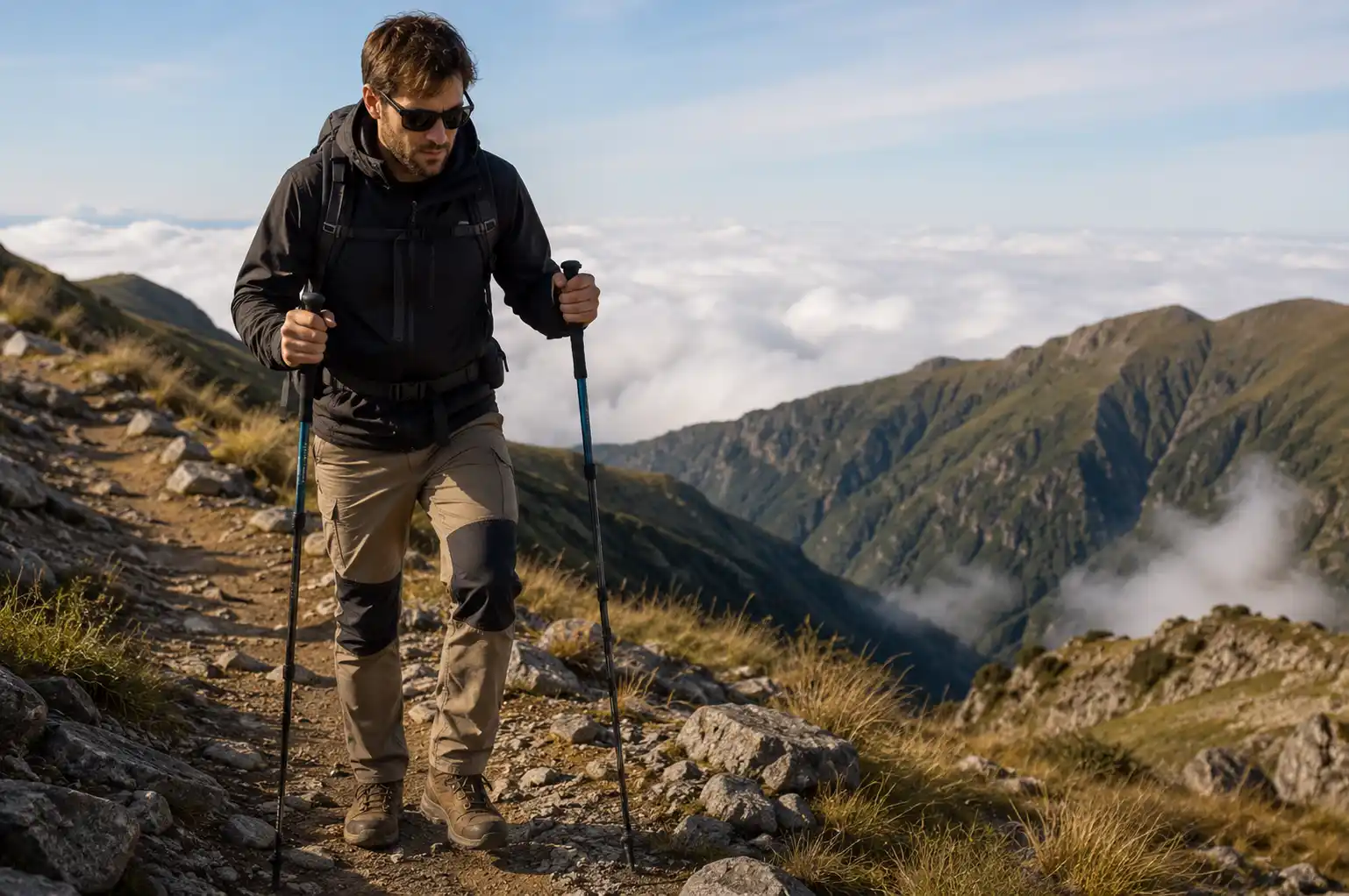
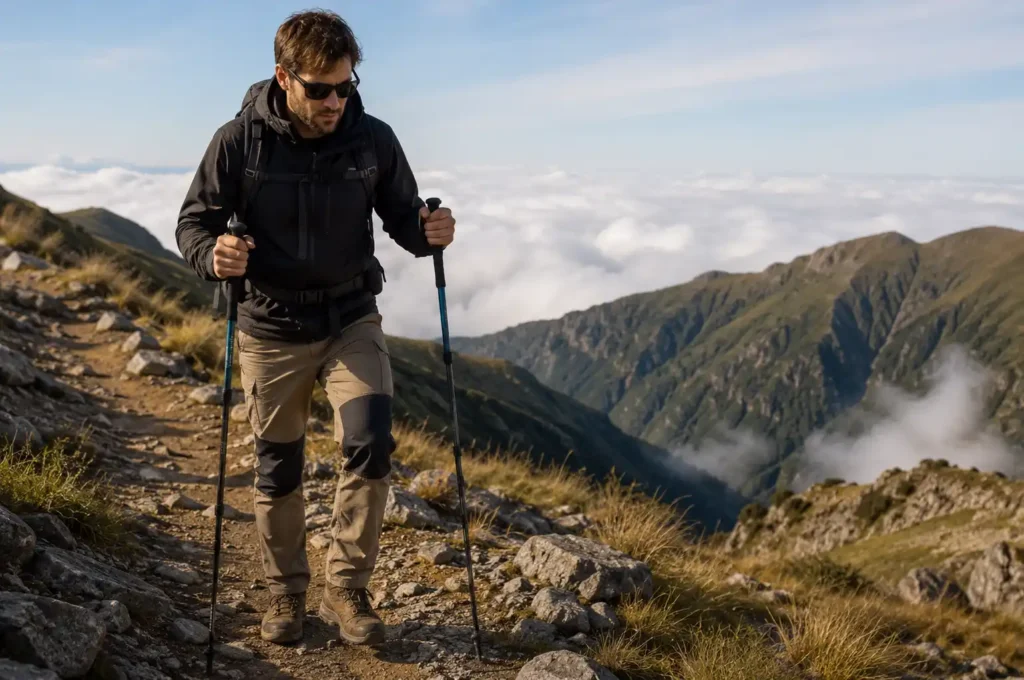
Proper Pole Height
On flat ground, your elbows should form approximately a 90-degree angle when holding the poles.
This creates efficient leverage without straining the shoulders.
Adjusting for Terrain
Uphill Hiking
Shorten poles slightly.
This improves leverage and keeps your arms comfortable during climbing.
Downhill Hiking
Lengthen poles slightly.
Longer poles help absorb impact and improve balance during descents.
The Opposite Arm and Leg Rule
The correct walking rhythm mirrors natural arm movement.
When your left foot steps forward, your right pole plants forward.
When your right foot steps forward, your left pole plants forward.
This alternating rhythm creates smooth, efficient movement.
The Strap Technique Most Beginners Miss
One of the biggest mistakes hikers make is gripping the poles too tightly.
Instead:
- Insert your hand upward through the strap
- Then grip downward onto the handle
This allows the wrist strap to support much of the weight.
Benefits include:
- Reduced hand fatigue
- Better control
- Less grip strain
- Improved comfort during long hikes
Proper strap use makes a huge difference during all-day trekking.
When Trekking Poles Are Less Useful
While poles are incredibly helpful most of the time, there are situations where they may become inconvenient.
Technical Scrambling
If you need both hands for climbing over rocks or steep terrain, poles may become awkward.
In these situations, many trekkers temporarily store their poles on their backpack.
Narrow Rock Sections
Certain exposed trails require maximum hand freedom for balance and grip.
Very Flat Trails
On smooth, flat walking paths, trekking poles are not strictly necessary.
However, some hikers still use them for maintaining pace and rhythm during long-distance walking.
Common Trekking Pole Mistakes
Using Poles That Are Too Long
Overextended poles create shoulder strain and poor mechanics.
Leaning Entire Body Weight on Poles
Poles should support movement, not completely replace leg function.
Failing to Adjust Pole Length
Terrain changes constantly. Pole length should adapt accordingly.
Carrying Poles Without Using Them
Many beginners simply carry poles awkwardly rather than integrating them into their walking rhythm.
Buying Cheap Low-Quality Poles
Budget poles often fail under pressure, especially during technical mountain trekking.
Reliable poles are worth the investment.
Trekking Poles and Long-Term Hiking Longevity
One of the greatest benefits of trekking poles is not immediate comfort — it is long-term sustainability.
Hiking places cumulative stress on the body over years.
Protecting your knees, hips, and back today helps ensure you can continue exploring mountains decades from now.
Many experienced trekkers who ignored poles earlier in life eventually adopt them after injuries or chronic joint pain develop.
Starting early is smarter.
Trekking poles are preventative tools, not signs of weakness.
Are Trekking Poles Worth It for Beginners?
Absolutely.
In fact, beginners often benefit the most because they typically:
- Have less technical balance experience
- Carry inefficient movement patterns
- Fatigue faster
- Feel less stable on rough terrain
Poles provide immediate support while helping new hikers develop better rhythm and posture.
Many first-time trekkers are surprised by how quickly trekking poles feel natural after only a few hours.
Conclusion: Invest in Your Body
There is a saying among experienced mountain guides:
“The climb up is optional. The climb down is mandatory.”
Most hiking injuries happen during descents, when fatigue, poor footing, and joint stress combine.
Trekking poles are one of the simplest and most effective tools for reducing that risk.
They improve stability, conserve energy, protect joints, enhance posture, and make trekking significantly more comfortable across all skill levels.
Whether you are planning your first mountain hike or preparing for a major expedition in 2026, trekking poles are an investment in both performance and longevity.
If you want to continue hiking comfortably for years to come, start using them now.
Need recommendations for durable, lightweight trekking poles for your next adventure? Check out our gear recommendations on our Extreme Travel Landing.