There is a direct correlation between the weight of your backpack and your enjoyment on a mountain trail. When you are standing in your living room packing for a major trek, it is incredibly easy to justify adding “just one more” fleece, an extra pair of jeans, or a heavy hardcover book. But when you are grinding up a steep, switchbacked mountain pass at 12,000 feet, every single ounce feels like a pound, and you will find yourself deeply regretting every non-essential item you brought along.
Mastering your packing for trekking is a delicate balancing act. You need to pack enough technical clothing and safety gear to protect yourself against unpredictable, volatile mountain weather—ranging from freezing midnight temperatures to blistering high-altitude sun. At the same time, you must keep your load light enough to walk comfortably for six to eight hours a day, day after day.
Whether you are heading out on a fully supported lodge-to-lodge trek in Nepal, a porter-assisted expedition on the classic Inca Trail, or a rugged self-supported wilderness loop, this guide is your definitive resource.
In this comprehensive guide, we will break down the essential “Three-Layer System,” provide an itemized multi-day gear checklist, outline what you should carry versus what a porter should carry, and share professional packing strategies to balance your load perfectly.
The Golden Rule: The Three-Layer Clothing System
Before you buy a single item on your checklist, you must understand how outdoor clothing works. In the mountains, heavy cotton clothes (like denim jeans or cotton t-shirts) are dangerous liabilities. When cotton gets wet from rain or sweat, it holds onto that moisture, loses its ability to insulate, and dries incredibly slowly, which can rapidly lead to hypothermia.
Instead, professional trekkers rely on synthetic fabrics (polyester, nylon) or natural merino wool organized into a Three-Layer System. This system traps warm air generated by your body while allowing sweat vapor to escape.
1. The Base Layer (Moisture Management)
This sits directly against your skin. Its primary job is to wick sweat away from your body so you don’t get chilled when you stop moving.
Material: Lightweight merino wool or high-performance synthetic fibers (like polypropylene).
- What to pack: 2–3 short-sleeve or long-sleeve thermal shirts and 1–2 pairs of thermal leggings for cold nights.
2. The Mid Layer (Insulation)
This layer traps the warm air your body produces. It should be breathable enough to let moisture escape but heavy enough to hold heat.
- Material: Polyester fleece or a lightweight down/synthetic puffer jacket.
- What to pack: 1 mid-weight fleece jacket and 1 high-quality down jacket (rated for freezing temperatures if trekking at high altitudes).
3. The Outer Layer (Weather Protection)
Commonly called the “shell,” this layer protects you from wind, rain, and snow. It must be completely waterproof but breathable enough that your sweat can escape.
- Material: Technical membranes like Gore-Tex, Pertex, or proprietary equivalents.
- What to pack: 1 high-quality waterproof jacket with a hood and 1 pair of waterproof rain pants.
The Complete Multi-Day Trekking Gear Checklist
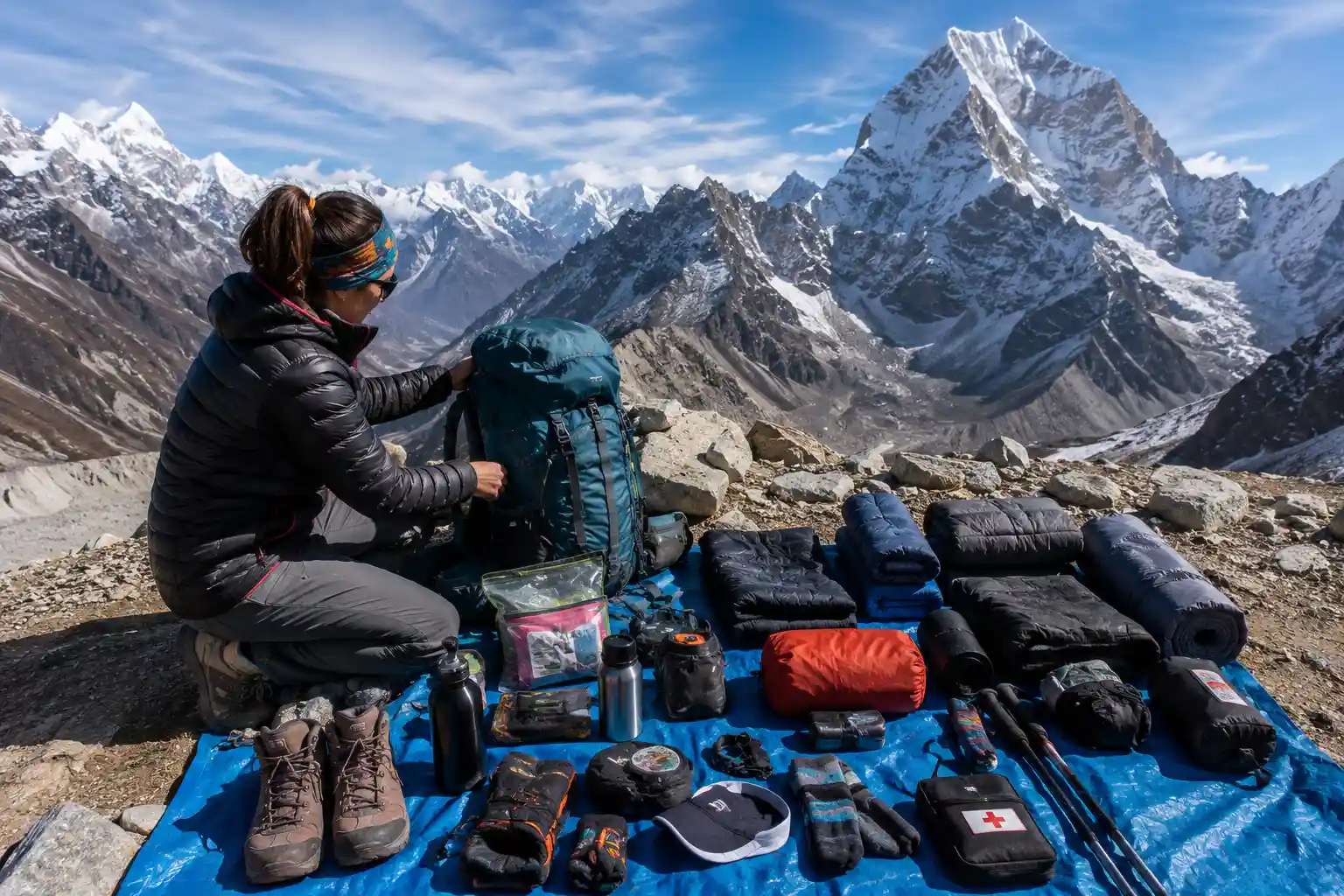
Use this comprehensive table to verify your inventory across the four main categories of trekking gear. Keep your choices focused on lightweight, durable, and packable options.
Technical Clothing & Footwear
| Item | Recommended Specification | Quantity |
| Hiking Boots | Broken-in, waterproof, high ankle support | 1 pair |
| Camp Shoes | Lightweight sandals, crocs, or trail runners | 1 pair |
| Hiking Socks | Thick wool-blend or merino wool (no cotton) | 3–4 pairs |
| Hiking Pants | Lightweight, quick-dry, convertible style | 2 pairs |
| Base Layer Tops | Merino wool or technical synthetic | 2–3 shirts |
| Mid-Layer Fleece | Full-zip or half-zip breathable fleece | 1 jacket |
| Insulated Down Jacket | Packable, high-loft down or synthetic fill | 1 jacket |
| Hard Shell Rain Jacket | Windproof, waterproof, breathable membrane | 1 jacket |
| Waterproof Rain Pants | Lightweight, packable with side zippers | 1 pair |
| Sun Hat & Beanie | Wide-brim for day; fleece/wool beanies for night | 1 of each |
| Gloves | Lightweight liner gloves + waterproof outer gloves | 1 pair each |
Hardware & Electronics
| Item | Recommended Specification | Quantity |
| Backpack | 35–45L for supported treks; 55–70L for independent | 1 pack |
| Trekking Poles | Adjustable, lightweight aluminum or carbon fiber | 1 pair |
| Headlamp | LED, adjustable brightness with extra batteries | 1 headlamp |
| Power Bank | 10,000 to 20,000 mAh rugged, high-capacity | 1–2 units |
| Water Bottles/Bladder | 1L Nalgene tough bottles or a 2–3L hydration bladder | Total 3L cap |
| Travel Adapter | Multi-region universal adapter | 1 unit |
Sleep Gear & Wilderness Comfort
| Item | Recommended Specification | Quantity |
| Sleeping Bag | Down fill rated to -10°C (14°F) or lower for high alt | 1 bag |
| Sleeping Bag Liner | Silk or fleece liner (adds warmth and keeps bag clean) | 1 liner |
| Sleeping Pad | Insulated inflatable or closed-cell foam pad | 1 pad |
| Microfiber Towel | Ultra-lightweight, quick-drying pack towel | 1 towel |
Personal Health, Hygiene & Sun Protection
| Item | Recommended Specification | Quantity |
| First Aid Kit | Blister treatment (Mole-skin), Ibuprofen, rehydration salts | 1 kit |
| Sunscreen & Lip Balm | SPF 50+ broad-spectrum water-resistant protection | 1 bottle each |
| Insect Repellent | DEET or Picaridin formula | 1 bottle |
| Biodegradable Wipes | Unscented, pack-it-out wet wipes | 1–2 packs |
| Hand Sanitizer | Pocket-sized high-alcohol gel | 2 bottles |
Supported Trekking: What Do You Actually Carry?
If you are booking a fully supported trek—such as a guided group trek through an agency—the logistical layout of your packing shifts dramatically. On these trips, heavy camping gear, cooking equipment, propane tanks, and the bulk of your personal luggage are transported ahead by human porters, pack horses, or pack mules.
- The Porter Duffel: You will be provided with a large, durable duffel bag (or you will use your own). You pack your sleeping bag, extra clothes, camp shoes, toiletries, and chargers into this bag. You will not have access to this bag during the day while walking, as the porters travel much faster than the clients and will head directly to the evening campsite or lodge.
- Your Daypack: You are responsible for carrying your own personal daypack (usually 25 to 35 liters). This pack should contain anything you might need access to between the morning trailhead and the evening camp.
Crucial Daypack Rule: Your daypack must always contain your rain gear, your insulation layer, at least two liters of water, your camera or phone, your passport, cash, personal medications, sunscreen, and a headlamp. Never separate yourself from your weather protection or hydration, even if the morning sky looks perfectly clear.
Professional Packing Strategies: How to Load Your Backpack
If you are doing an independent trek, or trying to pack your daypack efficiently, how you organize the gear inside your pack matters just as much as what you bring. A poorly packed backpack shifts your center of gravity, causing severe shoulder strain, lower back pain, and a higher risk of losing your balance on technical rocky terrain.
The Bottom Zone (Low Density, Soft Items)
Pack items you will not need access to until you reach your evening campsite or lodge at the very bottom of the bag. This provides a stable, cushioned base for the rest of your load.
- What goes here: Your sleeping bag, sleeping pad, camp shoes, and clean sleep clothes.
The Core Zone (High Density, Heavy Items)
The heaviest gear should always be placed close to your spine, roughly in the middle of your pack (between your shoulder blades). If you place heavy items at the top of your pack, the bag will feel top-heavy and tippy. If you place them too low or away from your back, the bag will pull you backward, straining your shoulders.
- What goes here: Water bladders, camp stove fuel, heavy camera lenses, and packed food rations.
Aisle Zone (Medium Density, Outer Edge)
Wrap lighter, medium-weight items around the heavy core to keep the pack uniform and prevent items from shifting.
- What goes here: Extra clothing layers, your tent body, and your secondary fleece.
The Top Pocket / Brain (High Accessibility Items)
The top lid of your pack (the “brain”) and the external zipper compartments should be reserved exclusively for small items you need to pull out in seconds without opening the main compartment.
- What goes here: Headlamp, rain jacket, map, compass, snacks, first-aid kit, and toilet paper.
3 Fatal Trekking Packing Mistakes to Avoid
- Bringing Brand-New Boots: Never step onto a multi-day trail with boots you bought the week before. Technical leather or synthetic boots require a substantial “break-in” period to soften and conform to your feet. Fail to do this, and you will develop severe, skin-tearing blisters within the first five miles, putting your entire expedition at risk.
- Overpacking “Just in Case” Clothes: You do not need a fresh outfit for every day of a trek. Everyone on the mountain smells like the mountain. Stick to two sets of trekking clothes (one to wear, one drying or airing out on your pack) and one clean, dry set reserved exclusively for sleeping.
- Ignoring Weight Limits on Bush Flights: If your trekking route requires a domestic flight to a remote airstrip (like flying into Lukla for Everest or taking a light aircraft across the Serengeti or Canada), realize that weight limits are non-negotiable due to aircraft safety. If your bag exceeds 15kg (33 lbs), you will be forced to leave gear behind at the airport or pay exorbitant cargo freight fees.
Conclusion: Light Backpack, Deep Experience
When you pack intentionally, stripping away the excess weight and relying on a streamlined, high-performance three-layer clothing system, you change your entire relationship with the trail. Instead of staring down at your boots, groaning under a painful load, and counting down the miles until camp, you can hold your head up, breathe in the thin mountain air, and absorb the breathtaking beauty of the ridges around you. Packing light isn’t about deprivation—it is about choosing freedom and safety on the mountain.
Ready to test your new gear layout on the world’s most spectacular paths? Explore the top regional routes and operational details on our Best Trekking Tours .
If you are still deciding which country matches your fitness and adventure goals, review our comprehensive analysis of the world’s Best adventure countries. Alternatively, if you are ready to lock in an unforgettable high-altitude adventure, connect with the WeGoExplore365 team to secure your permits and guides today.